Table of Contents
A commercial rice steamer price is shaped by the configuration a kitchen actually needs, the utilities and site work it requires, the delivery scope, and the documentation included with the order. A useful comparison starts with a written specification, so quotations describe equivalent equipment and responsibilities.
Why quotes for similar steamers can differ
Two products described as a commercial rice steamer may differ in usable tray positions, cabinet dimensions, heat source, controls, water connection, drainage, included accessories, and delivery terms. A commercial rice steamer price therefore cannot be compared accurately from a short product name or a photograph. It is a quote for a defined configuration and scope.
For a restaurant group, school caterer, hotel, or foodservice contractor, the purchase decision also reaches beyond the equipment line on the quotation. Space preparation, electrical or gas work, plumbing, unloading, installation, commissioning, and staff familiarization may be handled by different parties. A lower equipment figure can leave important project costs outside the quote. A higher one may include items that another supplier lists separately.
Start with the cooking job and service pattern
Before asking for a commercial rice steamer price, describe what the cabinet must do during a normal service period. Explain the number of meal periods, approximate batches, the time between preparation and service, and whether rice is the main product or one part of a wider menu. The important question is not only how much food is cooked in a day, but how much must be ready together at the busiest point.
Give suppliers the serving assumptions behind the estimate, including the portion size used by your operation and any expected seasonal or event peaks. These details help them discuss capacity without guessing. They also help prevent an oversized cabinet from occupying valuable space or a smaller unit from forcing the kitchen into extra batches during a narrow service window.
Batch timing depends on the appliance, recipe, rice variety, loading pattern, starting conditions, and operating method. Do not treat a general catalogue description as a guarantee of a particular cycle time or output. Ask which assumptions a supplier uses and request the model’s documented capacity and operating instructions before translating them into a service plan.
Cabinet size, trays, and usable capacity
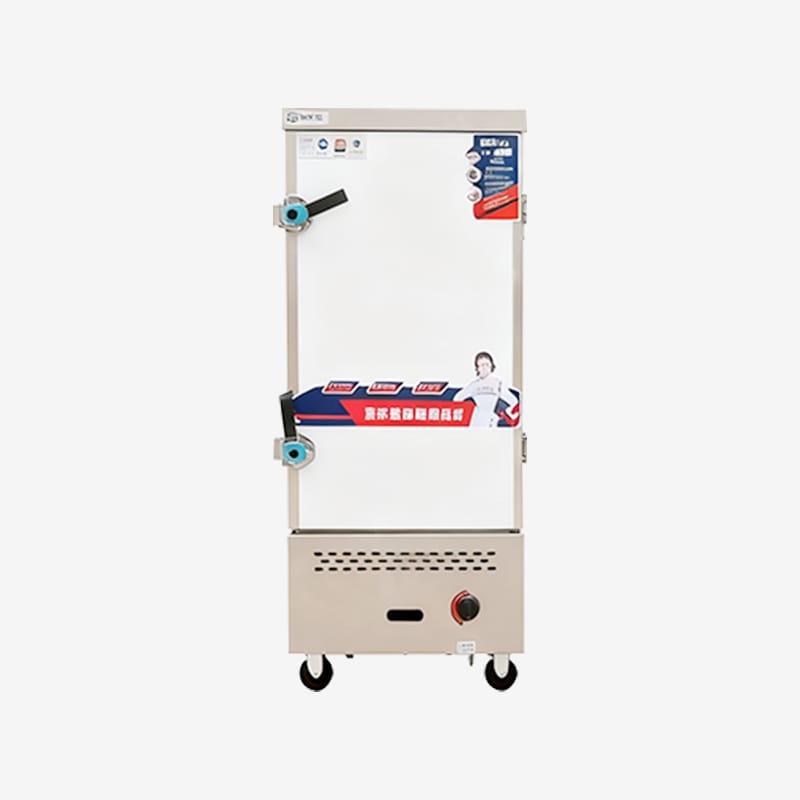
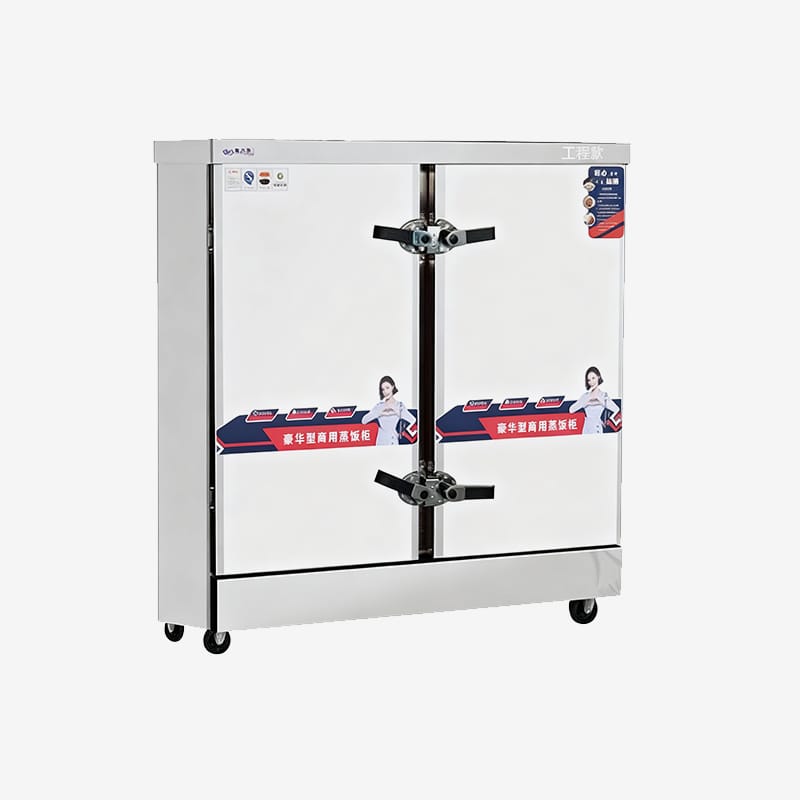
The configuration is one of the clearest drivers of a commercial rice steamer price. A single-door cabinet and a larger multi-position cabinet do not represent interchangeable capacity. Compare external dimensions, the number and spacing of tray positions, the tray format, and the loading access. Ask whether trays, racks, or other accessories shown in product images are included or optional.
Usable output depends on what fits safely and consistently inside the cabinet, not simply on the number of rails or shelves. A kitchen using several tray sizes should confirm compatibility before ordering. Check how staff will load hot trays, whether there is enough clearance to open the door fully, and whether the route from cooking to holding or service is practical. These details can affect the appropriate model even when two units appear similar in a catalogue.

For a project quote, provide the intended installation location and the clearances shown on the site plan. If a doorway, lift, corridor, or service entrance constrains delivery, mention it before the order is finalized. A cabinet that fits the kitchen footprint may still be difficult to move into the building or position beside the intended work area.
Heat source and utility readiness
Gas and electric configurations have different site requirements, so a commercial rice steamer price should be assessed alongside the utilities available at the installation point. For an electric model, confirm the voltage, phase, frequency, rated power, plug or connection arrangement, and local electrical requirements from the exact model documentation. For a gas model, confirm the fuel type, inlet requirements, connection details, ventilation expectations, and the qualifications required for installation in the destination market.
Do not assume that the kitchen’s existing connection is suitable because another appliance uses the same energy source. Have the relevant contractor or facilities team verify capacity and connection compatibility. If the site needs new circuits, gas piping, extraction, water supply, or drainage, those works may sit outside an equipment supplier’s quotation. A written responsibility split makes the commercial rice steamer price easier to interpret and reduces late changes.
Energy use is a lifecycle consideration, but it should be evaluated from the equipment’s documented rating and the way the kitchen operates. Avoid estimating annual consumption from an assumed daily schedule or a generic comparison. When reviewing an efficiency claim, ask for the underlying model-specific evidence and check whether the product falls within the scope of the cited program. ENERGY STAR provides information on commercial foodservice equipment and steam cookers; its criteria should not be assumed to apply to every rice cabinet.
Water, drainage, and cleaning requirements
Some steam cabinets need a water connection, a drain, or both, while the exact arrangement depends on the model. A commercial rice steamer price can include different connection components or installation boundaries, so request a model-specific utility schedule. The kitchen planner should confirm connection locations, access for maintenance, floor conditions, and whether the proposed position allows staff to clean around and behind the cabinet.
Cleaning access is a practical procurement issue because a unit that is difficult to reach can complicate routine care. Confirm which surfaces and removable parts require cleaning, how staff access them safely, and what the manufacturer recommends for water quality and descaling where applicable. Avoid using aggressive chemicals or procedures unless the equipment instructions permit them. If local food premises rules apply, the operator should verify the current requirements with the relevant authority.

Materials, controls, and included components
Construction details can change the commercial rice steamer price and the way a unit suits a project. Request the stated material and finish for the cabinet and food-contact components, along with the warranty terms and care instructions. Do not infer a steel grade, thickness, certification, or service life from appearance alone. Those details should be confirmed in the technical documents for the quoted model.
Controls should be assessed against the staff workflow. Ask how the operating settings are selected, what indicators are provided, whether the unit has a timer or other control functions, and which features are standard on that exact configuration. If the kitchen expects operators to work across multiple shifts, ask whether the supplier can provide clear operating instructions in a language staff can use. The answer should be recorded as part of the order documentation rather than left as a verbal assumption.
List every included component in the quote. This may include trays, racks, water fittings, drain parts, power cables, manuals, or other accessories, depending on the model and supplier scope. Make a separate note of items shown in images that are not included. When one quotation bundles accessories and another separates them, comparing only the headline commercial rice steamer price can produce the wrong conclusion.
Delivery, installation, and after-sales scope
Shipping terms affect the landed project cost and the buyer’s responsibilities. Clarify the destination, delivery term, packing method, estimated dispatch window, unloading arrangements, and who manages import clearance or local taxes where relevant. These items are not always included in the equipment figure. A commercial rice steamer price without a defined delivery scope is incomplete for a project budget.
Installation may require local tradespeople even when a supplier provides technical guidance. Confirm who connects utilities, positions the equipment, checks safe operation, and handles any commissioning steps. Ask what support is available if a part is damaged in transit or a component needs replacement, and how the buyer should identify the model and parts when requesting service. A clear process is more useful than a broad promise of support.
Lead time should be tied to the actual configuration and order approval process. Ask when the production or dispatch schedule begins, what information must be approved first, and how changes to voltage, finish, accessories, or shipping address affect the timeline. Do not rely on a generic lead-time statement if the project has a fixed opening date. Include a reasonable buffer for site preparation and local delivery.
Compare quotations on the same basis
Request that each supplier quote the same operating assumptions and configuration. A like-for-like commercial rice steamer price comparison should identify the model, capacity basis, heat source, utilities, included accessories, delivery boundary, warranty, and service scope. If a supplier recommends a different cabinet size, ask what changed and why. The point is to understand the trade-off, not to force every bidder to quote an unsuitable model.
| Quotation area | What to confirm | Why it matters |
|---|---|---|
| Configuration | Model, cabinet dimensions, tray positions, accessories | Shows whether the equipment fits the service need and site |
| Utilities | Energy source, ratings, water, drain, ventilation | Reveals site work and compatibility questions |
| Construction | Documented materials, finish, controls, warranty | Separates stated specifications from visual assumptions |
| Delivery | Destination, shipping term, packing, unloading | Defines what is and is not included in the quote |
| Support | Installation boundary, manuals, parts and service process | Clarifies responsibilities after dispatch |
When reviewing a commercial rice steamer price, record unanswered questions beside each quotation and resolve them before comparing totals. If a line item is not stated, mark it as unconfirmed rather than assuming it is included. This simple discipline makes internal approvals easier because decision-makers can see the specifications, exclusions, and risks behind each offer.
Prepare an accurate request for quotation
A complete inquiry helps a supplier return a more useful commercial rice steamer price. Include the business type, destination country and postcode, intended daily and peak service pattern, target output assumptions, available floor area, door and delivery access, preferred energy source, site utility details, and any required documentation. Attach a plan or photographs only when they help explain the installation location, and avoid sending confidential site information that is not needed for the quotation.
If the utility details are not yet known, say so and ask the supplier to identify the model information your contractor will need. If a project needs a specific certification or local approval, name the exact requirement and jurisdiction. Suppliers should confirm whether the requested evidence applies to the quoted model; a general company statement is not a substitute for product documentation.
For capacity planning, compare cabinet options against the method described in the commercial rice steamer capacity guide. For product availability and model inquiries, review the rice steaming cabinet range and provide the model or configuration you want assessed. These pages support different parts of the decision: operational sizing and a model-specific inquiry.
Understand the foodservice and energy references
Equipment selection should be checked against the project location and the operating rules that apply there. In the United States, the FDA Food Code is a model offered for adoption by state, local, tribal, and territorial jurisdictions; buyers should verify the rules adopted by the authority responsible for their establishment. Review the FDA Food Code resources as a starting point, not as confirmation that a particular cabinet is approved in every location.
Likewise, energy labels and efficiency programs apply to defined product categories and models. ENERGY STAR’s commercial foodservice equipment information includes steam cookers, but a rice steaming cabinet should not be described as certified unless the exact product listing confirms it. Ask for current model-specific documentation when an efficiency designation is important to procurement.
Frequently asked questions
What information is needed for a commercial rice steamer price?
Share the destination, service pattern, capacity assumptions, preferred energy source, site dimensions, utility details, accessory needs, and delivery requirements. The supplier can then identify a model and state what the quotation includes.
Does a larger rice steamer always cost more to operate?
Not necessarily. Operating cost depends on the model’s documented ratings, actual loading, cooking schedule, utility rates, and staff practices. Compare model-specific information and realistic usage assumptions rather than cabinet size alone.
Should gas or electric be selected by equipment price?
No. Confirm site utility capacity, local installation requirements, availability, and the operating pattern first. The equipment quote is only one part of the decision; the project team should assess connection and installation scope as well.
Can suppliers quote without a final kitchen plan?
They can often provide an initial estimate if the buyer supplies approximate dimensions, utility information, and service needs. Treat it as provisional until the model, site conditions, delivery route, and included components are confirmed.
What should be compared besides the quoted amount?
Compare the exact configuration, documented capacity basis, materials, controls, accessories, delivery terms, exclusions, warranty, installation boundary, manuals, and parts support. Ask suppliers to clarify every item that is missing or described differently.
Request a model-specific quotation
The most useful commercial rice steamer price is one connected to a real kitchen requirement and a clear scope. Before requesting a quote, align the service pattern, capacity assumptions, cabinet dimensions, utilities, delivery route, accessories, and project responsibilities. Then ask Bafang to review the operating requirements and confirm the available configuration, technical documents, and quotation inclusions for your destination. A specific inquiry makes the next comparison more reliable and helps the project team identify open installation questions early.