Table of Contents
Choosing a rice steamer for school canteens is not simply a matter of selecting the largest cabinet available. The right equipment must fit the menu, the time available between preparation and meal periods, the staff routine, the building services, and the local food-safety requirements. A good specification starts with the number and type of portions the kitchen must prepare, then tests whether the proposed cabinet can support that workflow without crowding the cooking line or creating difficult cleaning tasks. This guide explains how school foodservice teams can frame those decisions before requesting a quotation.
Define the service model before choosing equipment
School meal programs differ in how food is prepared and served. A kitchen may cook for one campus, prepare components for multiple serving points, or work with a menu that changes by day. The rice steamer for school canteens should be evaluated against the actual service pattern, not an assumed restaurant schedule. Record when rice must be ready, whether portions are served immediately or held under an approved procedure, and how staff handle a late delivery or a change in attendance. These details affect the useful batch size and the time window in which a cabinet must complete its work.
Talk with the foodservice manager, cooks, facilities staff, and procurement lead before writing the specification. Each group sees a different operational constraint: cooks understand loading and unloading, managers know the menu and service sequence, facilities staff understand utilities and access, and procurement needs comparable, complete quotations. In a school, the equipment may be used by staff with varied experience, so operating controls and routine instructions should be understandable and easy to incorporate into training. The decision should not rely on a single feature such as tray count.

Translate the menu into a production requirement
Start from the recipes and serving plan rather than a supplier’s general capacity label. List the rice dishes the kitchen expects to prepare, the serving portion used by the program, the number of students served in each period, and any expected second service. Convert those inputs into a practical production target with the foodservice team. A rice steamer for school canteens should be sized for a defined menu and operating day; a theoretical maximum that ignores pan depth, recipe method, loading access, or staffing can overstate the useful output.
Keep the assumptions visible. Attendance can change, recipes may use different grain varieties, and rice may share equipment time with other dishes. A school that serves several staggered groups may need a different sequence than one serving the whole campus at once. If the kitchen plans to cook multiple batches, map the loading, cooking, unloading, and cleanup intervals. This reveals whether one cabinet can meet the schedule or whether the real constraint is labor, counter space, or the time required to move hot pans safely.
Ask the supplier which test conditions underpin any stated capacity. Confirm whether the figure refers to a particular tray, pan, recipe, or cycle and whether accessories are included. Do not treat a catalogue number as a guaranteed meal count unless the conversion method and operating assumptions are clear. The school can compare options more fairly when each supplier responds to the same written menu, quantity assumptions, and service timetable. This also helps avoid buying a rice steamer for school canteens that appears adequate on paper but proves awkward during a real lunch period.
Plan batches around the school timetable
School kitchens often work within a narrow preparation window shaped by class schedules, delivery times, and fixed meal periods. Draw a simple time line for a representative day. Include ingredient preparation, cooking start, estimated cycle completion from the exact model documentation, unloading, any permitted holding step, service, and cleaning. A rice steamer for school canteens must fit this sequence with realistic staff coverage. Build in a contingency for a delayed start or a small menu adjustment instead of assuming every task begins precisely on schedule.
Where the menu calls for more than one batch, identify what happens while the first batch is cooking. Staff may be preparing vegetables, assembling trays, or handling other hot equipment. Avoid a plan that requires one person to monitor several tasks in locations that cannot be supervised safely. If service is staggered, determine whether a later batch can be started at a time that produces the required quality and timing. The equipment manual, recipe trials, and local food-safety procedures should guide the final routine.

Match cabinet capacity to staff and space
More capacity is useful only when the kitchen can load, operate, unload, and clean the cabinet appropriately. Measure the proposed location and the route from receiving or storage to the cooking line. Include door swing, service access, nearby work surfaces, and the space needed to stage pans. A rice steamer for school canteens should not block the route between preparation and service or force staff to carry hot food across a busy aisle. Confirm dimensions from the current model drawing rather than estimating from a product photograph.
Consider the number of trays or racks in relation to the people assigned to the task. A larger load may be difficult to handle if there is insufficient landing space or if the unloading procedure requires repeated reaching. Check whether accessories can be lifted and washed using the school’s existing sinks and dishwashing area. Where a unit will be used by a rotating team, consistent tray positions and clear instructions can make handover easier. These are practical design questions, not merely convenience details, because they influence whether the equipment can be used as intended every day.
Review electrical or gas requirements, water connections where applicable, ventilation, drainage, and clearances with the facilities team and the manufacturer. Requirements vary by model and jurisdiction, so the purchase specification should refer to the selected unit’s documentation. Do not assume that an existing connection is suitable because another appliance once used the same location. For renovation work, identify who is responsible for the building modifications, installation, permits, inspection, and commissioning. A site-ready plan makes it easier to compare the cost and scope of competing offers without relying on incomplete assumptions.
Design a safe movement and holding workflow
Trace the path of rice from preparation to cooking, from the cabinet to any approved holding point, and from there to the serving line. The route should keep hot pans away from student traffic and avoid crossing wet-floor or dish-return paths. Decide where staff will place utensils, lids, and clean trays so they do not occupy an egress route or a food-preparation surface. In a school kitchen, these choices also shape supervision: staff should be able to manage equipment while maintaining awareness of the work area.
Do not assume that cooking equipment itself determines a safe holding time or temperature. Those procedures must follow the local authority’s rules, the school’s food-safety plan, and the product instructions. The U.S. Food and Drug Administration publishes the FDA Food Code as a model reference for jurisdictions; school operators should confirm which requirements their authority has adopted. For broader program planning, the USDA Food and Nutrition Service provides resources for school meal programs. These references inform policy and program administration, but they do not replace local direction or model-specific operating instructions.
Confirm utilities and installation details
Before placing an order, obtain the technical sheet and installation instructions for the exact rice steamer for school canteens under consideration. Confirm the rated supply, connection type, operating environment, water arrangement, drainage, and any required clearances. Ask whether the model is supplied with the fittings and accessories shown in the quotation. If a value is not published, request written confirmation from the supplier instead of filling the gap with a general online estimate.
Assign responsibility for site preparation. The school facilities team may need to verify the connection point, while a qualified contractor carries out work that must comply with local code. The supplier should clarify the boundary between equipment supply and building services. Record model number, electrical or gas specification, accessory list, connection drawing, delivery route, and installation scope together. This written record helps staff and contractors resolve questions before delivery, when a change can be planned rather than improvised on a busy school day.
Make cleaning practical between service periods
Ask staff to walk through the cleaning routine before purchase approval. Identify which parts are removable, how they are handled, where they are washed, and how the unit is allowed to cool or be isolated before cleaning. Confirm the approved products and methods from the manufacturer’s instructions. A rice steamer for school canteens should fit the cleaning resources already available or prompt a clearly scoped plan for any additional equipment. A cleaning routine that depends on inaccessible corners or unclear responsibilities is less likely to be performed consistently.
Build the maintenance task into the school’s operating calendar and decide who records completion. Staff should know how to report damage, unusual operation, or a part that needs service, and they should not be asked to repair electrical, gas, or pressurized connections unless qualified and authorized. Keep the manual, model identification, service contact, and approved cleaning instructions where the responsible team can find them. Training should cover normal operation, shutdown, cleaning, and escalation routes rather than only the start button.

Compare configurations on the same basis
| Decision point | What to confirm | Why it matters to a school |
|---|---|---|
| Useful batch size | Recipe, tray, and test conditions behind capacity | Connects specifications to the menu and meal period |
| Operating sequence | Cycle information and staff steps from the manual | Supports timetable and labor planning |
| Site fit | Dimensions, access, swing, and service clearances | Protects aisle flow and maintenance access |
| Utilities | Exact connection and installation requirements | Prevents scope gaps before delivery |
| Cleaning | Removable parts, method, and staff responsibility | Makes daily care workable with existing resources |
| Documentation | Manual, warranty terms, accessories, and service route | Creates a usable record for staff turnover and maintenance |
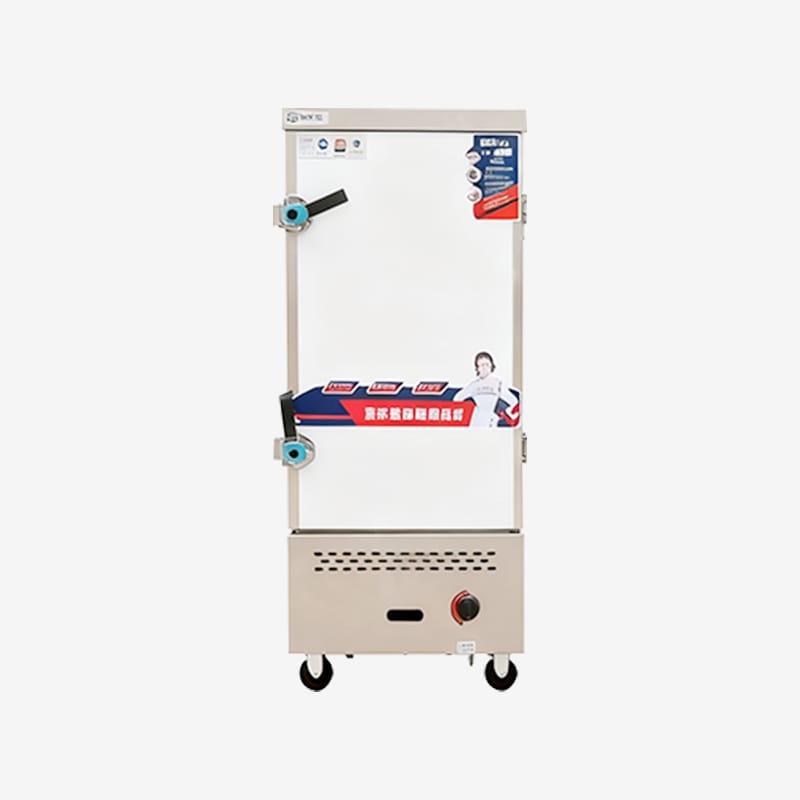
Request each supplier to respond to the same questions and identify assumptions separately from confirmed specifications. Compare the complete configuration, not just the cabinet name: included trays, controls, utilities, delivery conditions, installation responsibility, training documents, and service support all affect suitability. The Bafang rice steaming cabinet range can help the school identify models for review. For planning batch needs, use the rice steamer tray capacity guide as a companion resource, then verify final details against the selected model documentation.
Prepare a school-ready procurement brief
A complete brief should state the menu and expected service pattern, the operating location, the available utilities, the planned cleaning arrangement, and any local approval process. Include drawings and photographs of the site only where the school is permitted to share them with suppliers. Ask vendors to identify what they need clarified before they can recommend a model. A rice steamer for school canteens is a considered facilities purchase, so procurement can benefit from an agreed evaluation method and documented sign-off by the foodservice and facilities leads.
When comparing proposals, separate mandatory requirements from preferences. A required connection or access condition should be verified, while finish options or optional accessories may be compared based on the school’s needs. Avoid selecting solely on a headline output claim. Review the response against the actual meal schedule and confirm that the proposed configuration can be installed and maintained at the intended site. Keep a record of questions, answers, model revisions, and approvals so the delivered unit can be checked against the accepted specification.
Frequently asked questions
How should a school estimate rice steamer capacity?
Start with the menu, serving portion, attendance assumptions, and number of meal periods. Confirm how the manufacturer defines capacity for the exact model and recipe conditions.
Can one rice steamer serve multiple school meal periods?
It depends on cycle timing, batch size, staff availability, and the approved food-handling procedure. Map the complete sequence and validate it with the selected model documentation.
What should a school verify before installation?
Confirm model-specific utilities, clearances, drainage or water arrangements, access, delivery route, and local approvals with the manufacturer and qualified contractors.
Does the equipment determine the school’s holding procedure?
No. Follow the local authority’s adopted requirements, the school food-safety plan, and the appliance instructions. Confirm local rules before service begins.
What documents should be retained after purchase?
Keep the accepted specification, model and serial details, manual, installation record, approved cleaning instructions, warranty terms, and service contacts with the facilities file.
Discuss a school kitchen configuration
Share the school’s service schedule, menu assumptions, kitchen drawing, and available utility information when requesting a configuration review from Bafang. A clear brief lets the team assess which rice steamer for school canteens is worth evaluating and which site questions still need confirmation before procurement.
For food program context, consult the USDA Food and Nutrition Service Child Nutrition Programs resources. For food-safety requirements, review the FDA Food Code and confirm the version and rules adopted by the local authority. Neither source substitutes for the school’s applicable regulations or equipment manual.