Table of Contents
Introduction

If you’re building or upgrading a professional kitchen — for a restaurant, hotel, bakery, or catering business — selecting the right workbench is a decision you don’t want to leave to chance. A commercial kitchen workbench isn’t just a table — it’s a durable, hygienic, dependable foundation for all food‑preparation tasks. The right bench improves workflow, enhances sanitation, and ensures that your kitchen can handle heavy use day after day.
In this guide, you’ll learn what defines a commercial kitchen workbench, why stainless steel is the industry standard, the common types and configurations available, their typical dimensions and load capacities, and exactly how to choose a bench that fits your kitchen’s needs and meets hygiene standards.
What Is a Commercial Kitchen Workbench?
A commercial kitchen workbench is a heavy-duty table designed specifically for food preparation in professional kitchens. Compared to a standard home kitchen countertop, these workbenches are built with durability, hygiene, and high usage in mind.
Key characteristics include:
- Industrial‑grade construction that can withstand heavy equipment, continuous use, and frequent cleaning.
- Food‑safe, non‑porous surfaces to reduce contamination risk.
- Spacious workspace suitable for chopping, mixing, plating, organizing ingredients.
- Easy maintenance: resistant to stains, rust, moisture, and frequent sanitization.
Many commercial workbenches also include undershelves, drawers, splashbacks (backsplashes), or castors — features that enhance storage, organization, hygiene, and workflow flexibility.
Why Stainless Steel Is the Preferred Material
Among possible materials, food‑grade stainless steel stands out as the most widely used for commercial kitchen workbenches — and for good reason. According to industry suppliers and fabricators, stainless steel offers excellent corrosion resistance, durability, and hygienic properties.
Here are the main advantages of stainless steel workbenches:
- Hygiene & Cleanability: Stainless steel surfaces are non‑porous and easy to sanitize. A simple wipe-down with soap and water — or approved sanitizing solutions — removes food residue, oils, and bacteria.
- Corrosion & Heat Resistance: Stainless steel resists moisture, acidic ingredients, cleaning chemicals, and heat — all common in busy commercial kitchens.
- Durability & Longevity: Properly fabricated stainless workbenches — especially those using 304 or 316 grades — can survive decades of heavy use without warping, rusting, or deteriorating.
- Load-bearing Capacity: Quality stainless benches are engineered to support heavy loads — often countertop equipment, large ingredient containers, or multiple prep tasks — without compromising stability.
- Regulatory Compliance: Stainless steel is widely accepted by health and safety authorities because it meets standards for hygiene, cleanability, and food‑safety compliance when properly fabricated (smooth welds, non‑porous surfaces, seamless design).
Because of these benefits, stainless steel has become the de facto standard for commercial kitchen workbenches worldwide.
Common Configurations & Use Cases — Choosing What Fits Your Kitchen
No two kitchens are exactly alike. Depending on your volume, menu, workflow, and layout, you might need different types of workbenches. Below is a summary of common configurations and where they shine:
| Workbench Configuration | Typical Use Case | Key Advantages |
|---|---|---|
| Standard flat‑top workbench | General food prep, chopping, mixing, plating | Simple, durable surface; easy to clean; suitable for most kitchens |
| Workbench with splashback | Prep areas near walls or sinks | Prevents spills/splashes on walls; improves hygiene and ease of cleaning |
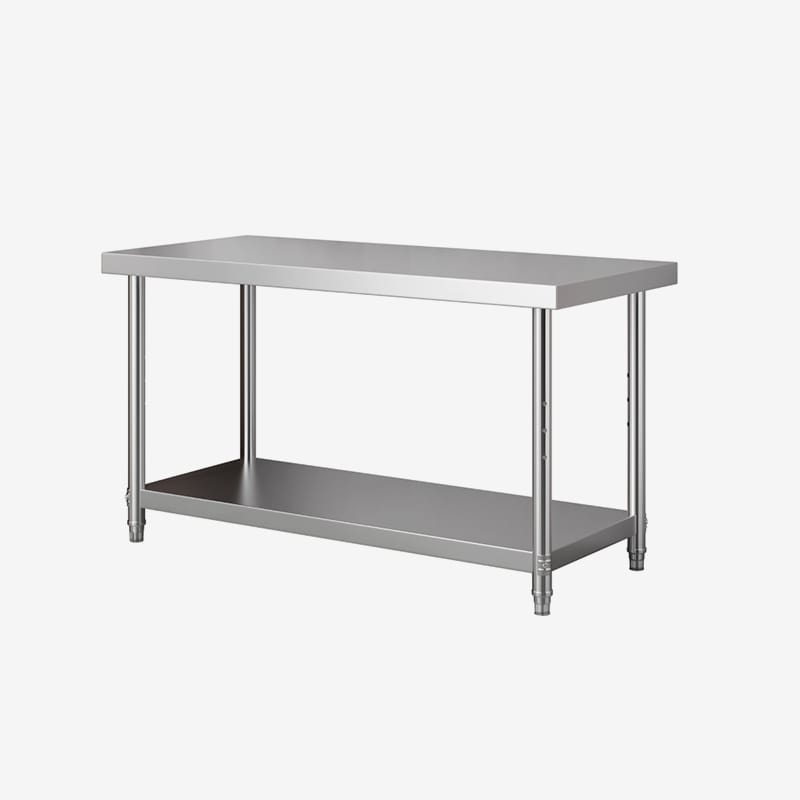
| Workbench with undershelf or drawers | Kitchens needing organized storage of utensils, trays, ingredients | Maximizes space, reduces clutter on work surface |
| Adjustable‑height or ergonomic workbench | Tasks requiring variety or staff comfort (e.g. long prep sessions) | Reduces fatigue, improves ergonomic workflow |
| Mobile workbench on wheels (casters) | Flexible kitchens, seasonal menus, movable prep stations | Easy to reconfigure layout; supports flexible operations |
| Custom/modular workbenches (sink‑integrated, tailored sizes) | Specialized kitchens (bakeries, catering, labs) or unique layouts | Fits exact needs, maximizes efficiency, supports special tasks |
By combining several types, many kitchens create a flexible, efficient working environment — for example, using a flat‑top bench for prep, a splashback bench near washing area, and mobile benches for flexible tasks.
Typical Dimensions & Load Capacity — What You Should Know Before Ordering
Based on industry data from several commercial kitchen suppliers, common dimensions for stainless steel workbenches are:
- Length: 1800 mm to 3000 mm (approx. 71–118 inches)
- Width (depth): 600 mm to 900 mm (approx. 24–36 inches)
- Height (work surface): Typically around 34–38 inches, matching standard counter height and ergonomic norms.
As for load-bearing capacity: many standard stainless workbenches are rated to support 500–700 lbs (≈225–320 kg) of evenly distributed weight on the top surface. Some heavy-duty or reinforced models — with thicker gauge and more robust leg/support structures — can support 800 lbs (~360 kg) or more when properly engineered.
For your kitchen planning, that means these benches can comfortably support countertop equipment (mixers, dough rollers, prep machines), large ingredient containers, or heavy trays — provided you pick the right type based on gauge, leg build, and reinforcement.
How to Choose the Right Workbench for Your Kitchen — Practical Checklist
When selecting a commercial kitchen workbench, consider the following criteria to ensure your decision supports long-term performance, hygiene, and efficiency:
- Material & Grade: Favor food‑grade stainless steel (304 for most kitchens; 316 if you expect heavy moisture, salt exposure — e.g. seafood prep or coastal areas).
- Gauge / Thickness & Construction: Thicker gauge (lower gauge number, e.g. 14–16 gauge) and strong frame/leg construction provide better load capacity and prevent warping or sagging under weight. Reinforced undershelves or gussets help for heavy use.
- Configuration & Storage Needs: Evaluate whether you need simple flat surfaces, splashbacks for wall/sink adjacency, undershelves/drawers for storage, or mobility for flexible layout.
- Dimensions vs Kitchen Layout: Measure your kitchen workspace carefully. For high-volume prep you may need long benches; for limited space, compact benches with storage help maximize utility.
- Hygiene & Compliance: Ensure surfaces are smooth, weld seams are sealed, and materials meet food‑safety requirements. Stainless steel benches often meet or exceed health-code standards.+1
- Load Requirements: Match bench load capacity with equipment and ingredient weight. Under-designing leads to instability; over-specifying may increase cost unnecessarily.
- Long-Term Value: Consider maintenance, ease of cleaning, durability under heavy use — investing in quality often pays off in lower replacement and repair costs.
- Supplier / Fabrication Quality: Confirm the manufacturer uses proper welding, finishing, and post‑fabrication inspection for quality and safety compliance.
By working through this checklist, you can make an informed choice — giving your kitchen a workbench setup that supports productivity, hygiene, and durability.
Conclusion
A commercial kitchen workbench is far more than a simple table — it’s a critical component of any professional kitchen’s workflow, safety, and long-term operation. Selecting the right workbench means balancing material quality, configuration, size, load capacity, hygiene standards, and the nature of your kitchen tasks.
For most kitchens, food‑grade stainless steel benches — especially those crafted from 304 or 316 grade stainless — remain the gold standard. They offer unmatched durability, hygiene, heat and corrosion resistance, and load handling. Although the initial investment may be higher than with alternative materials, their long lifespan, low maintenance, and reliability under heavy, daily use make them a smart and cost‑effective choice over time.
Whether your kitchen is small or large, high‑volume or specialized, carefully planning your workbench setup — combining flat‑tops, splashback units, benches with storage, and mobile tables — will help you achieve a clean, efficient, ergonomic, and compliant workspace. Treat your workbench as the backbone of your kitchen: choose wisely, and it will serve you for years to come.
FAQ
Why is stainless steel preferred over wood or plastic for commercial kitchen workbenches?
Stainless steel provides a non-porous, corrosion-resistant, easy-to-clean surface that withstands heavy use, heat, moisture, and chemical cleaning agents. Unlike wood or plastic, it doesn’t absorb moisture or harbor bacteria — critical for food safety and compliance.
What stainless steel grade should be chosen — 304 or 316?
For most kitchens, 304 stainless steel strikes the best balance between cost, corrosion resistance, and durability. If your kitchen environment involves frequent exposure to salt (seafood prep), heavy moisture, or harsh cleaning cycles, 316-grade stainless provides better corrosion resistance and longer lifespan.
How much weight can a commercial stainless workbench typically support?
Standard commercial stainless workbenches usually support between 500 and 700 lbs (≈225–320 kg) of evenly distributed weight. Reinforced, heavy-duty models with thicker gauge and stronger frame can support 800 lbs (≈360 kg) or more. Always check the manufacturer’s specifications before placing heavy equipment on the bench.
What dimensions are common for commercial kitchen workbenches?
Common sizes range from about 1800 mm to 3000 mm in length, 600 mm to 900 mm in width, and a typical work surface height around 34–38 inches — suitable for most kitchens and ergonomic for food prep tasks.
How should I decide between different workbench types (flat-top, with splashback, with undershelf, mobile)?
Your selection should be guided by your kitchen’s layout, workflow, volume, and storage needs. For general food prep and plating, flat-top benches suffice. If your bench is near walls or sinks, splashback benches add cleanliness and protection. If storage space is limited, benches with undershelves or drawers help. For flexible or dynamic kitchen layouts, mobile benches on casters provide versatility. A mix of bench types often yields the best long-term efficiency.